


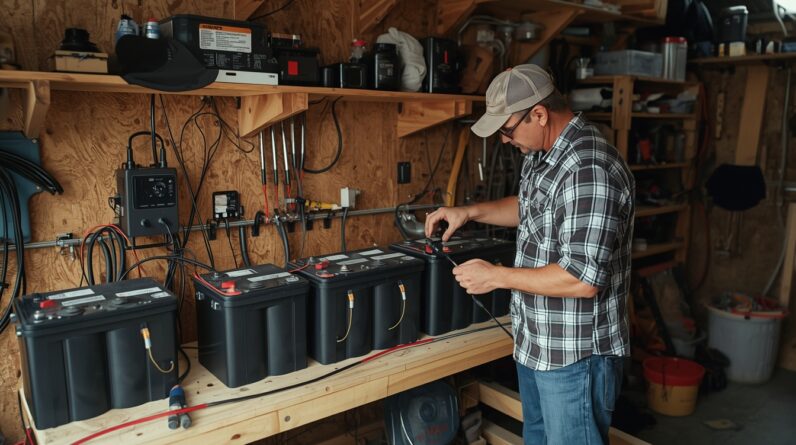
Not long ago, a friend of mine decided he wanted backup power for his home.
Nothing fancy. He just wanted enough electricity to keep the lights on, charge phones, and run a few essentials if the grid went down.
After doing some research, he realized something interesting.
The most important part of a small backup power system wasn’t the solar panels or the generator.
It was the battery bank.
The battery bank is what actually stores the electricity so you can use it later. Without it, solar panels only produce power when the sun is shining, and generators only work while they’re running.
Once he built a simple battery bank, everything else became easier.
The good news is that a basic battery bank setup is well within reach for many homeowners—as long as you follow the right safety steps and understand the fundamentals.
What Is a Battery Bank?
A battery bank is simply a group of batteries connected together to store electricity.
These batteries collect energy from sources such as:
- solar panels
- generators
- grid charging
- small wind systems
Once stored, the electricity can be used later to power household devices through an inverter.
Many small home systems use 12-volt battery banks, while larger setups may use 24-volt or 48-volt systems.
For beginners, a 12-volt system is usually the easiest place to start.
If you’re new to solar systems, it helps to understand the basics first. Our guide Solar for Beginners walks through the core components of a small home solar setup.
Tools You’ll Need
Setting up a basic battery bank doesn’t require a workshop full of equipment.
Most DIY setups only require a handful of common tools.
Typical tools include:
- adjustable wrench
- insulated screwdriver
- wire cutters
- wire crimping tool
- digital multimeter
The multimeter is particularly important because it allows you to safely test voltage and confirm that wiring connections are correct.
Choosing the Right Batteries
Not all batteries are suitable for energy storage systems.
Car batteries, for example, are designed for short bursts of power and are not ideal for repeated charging cycles.
Battery banks typically use deep-cycle batteries, which are built to handle repeated charging and discharging.
Common options include:
- flooded lead-acid batteries
- AGM batteries
- lithium batteries
Lead-acid batteries remain the most affordable option for many DIY systems, while lithium batteries offer longer lifespans and lighter weight.
For a beginner setup, many homeowners start with one or two deep-cycle batteries.
Wiring Batteries Together
Battery banks are built by connecting batteries together in either series or parallel configurations.
Understanding the difference is important.
Series Wiring
Series wiring increases voltage.
Example:
Two 12-volt batteries connected in series create 24 volts.
This is often used in larger systems.
Parallel Wiring
Parallel wiring keeps the voltage the same but increases storage capacity.
Example:
Two 12-volt batteries wired in parallel remain 12 volts, but the total energy storage doubles.
Many beginner systems use parallel wiring because it keeps the system simple.
Basic Battery Bank Setup
A typical beginner battery bank setup might look like this:
- Place batteries in a ventilated, dry location.
- Connect batteries using properly sized cables.
- Install a fuse or circuit breaker for protection.
- Connect the battery bank to the charge controller.
- Connect the inverter to the battery bank.
Once complete, the system allows stored electricity to power household devices safely.
Important Safety Tips
Working with electricity always requires caution.
Fortunately, a few simple safety rules can greatly reduce risk.
Important precautions include:
- Always disconnect power before working on wiring
- Use insulated tools whenever possible
- Install fuses or circuit breakers in the system
- Keep batteries in ventilated areas
- Wear protective gloves and eye protection when needed
Battery banks can store significant energy, so treating them with respect is essential.
Where to Store a Battery Bank
Location matters more than many beginners realize.
Battery banks should be stored in places that are:
- dry
- cool
- well ventilated
- protected from direct sunlight
Garages, utility rooms, and dedicated battery boxes are common locations.
Avoid placing batteries in extremely hot or freezing environments, since temperature can affect battery lifespan.
Expanding Your System Later
One advantage of battery banks is that they can often be expanded over time.
Many homeowners start with a small system and gradually add:
- additional batteries
- solar panels
- larger inverters
As your power needs grow, your system can grow with it.
This gradual approach keeps costs manageable while still building long-term energy independence.
The Foundation of Home Backup Power
Battery banks may not be the most exciting part of a home power system, but they are often the most important.
They allow you to store energy, stabilize your electricity supply, and keep essential devices running during outages.
For homeowners interested in reliable backup power, learning how battery banks work is a valuable skill.
And if you’re comparing different ways to generate electricity during outages, the next step is understanding which generators work best for real homes.
In our next guide, we’ll look at The Best Home Generators for Rural Families, including practical comparisons of several popular options.


